Skip to content
Courses / 42Courses / Biomimicry
4
42Courses

Biomimicry

9h

Three things you can really rely on.

A CPD-accredited Mini MBA.

Real recognition for real progress. Dated, signed, and easy to verify.

Marked by humans, not bots.

You are not shouting into the void. A real person reads what you submit and replies, usually within 24 hours.

Personalised to your role.

Every lesson is reshaped around your day-to-day work, so it sticks and you can put it to use straight away.


About this course

'We can't solve problems by using the same kind of thinking we used when we created them.' - Albert Einstein

Most of us want something straightforward, especially when everything around us feels more complicated by the week.

That's where biomimicry comes in, and honestly, it can feel like a breath of fresh air.

The word is drawn from Greek: bios meaning 'life' and m?m?sis meaning 'imitation.' In practice, it's about borrowing ideas from nature to tackle modern challenges.

It's a different way to think about solutions. Instead of starting from scratch, you look at how the natural world solves problems and then adapt those principles.

So why bother learning about it?

Because nature is basically the ultimate testing ground. After billions of years of evolution, across millions of species, it has refined strategies that work remarkably well in the real world. A lot of what we see today has been through the toughest version of trial and error.

You may be thinking, 'Sure, but how does that help with stuff we deal with now?' Fair question. From materials inspired by spider silk to greenhouse ideas borrowed from desert beetles, this course walks through plenty of real case studies.

You'll see how nature's playbook can apply across different industries, not just science labs.

And no matter what you do for work, you can use biomimicry. Think of it as a new arrow in your quiver for coming up with creative solutions and driving innovation.

Okay, so what's actually included?

The course begins with what biomimicry is, where it comes from, and why it matters. Then you'll move into the innovation process for turning a biomimicry idea into something that solves your specific problem. After that, we'll look at real-world examples of this so-called 'technology'.

You'll learn how shark skin can help with hospital bacteria issues and why it can stop barnacles attaching to ship hulls. You'll also explore how owl feathers have influenced quieter wind turbine designs, plus how a sailfish inspired ways to make a supercar faster.

By the end, you'll know how to bring biomimicry into your own toolkit for creative problem-solving and innovation.

Sounds interesting? Enrol today.
Image


What you'll learn:

  • See how the natural world can help untangle complicated problems
  • Find practical ways to do more with less
  • Get clear on the tradeoffs involved when you design solutions
  • Use nature as a creative spark for innovation
  • Learn both the top-down and bottom-up approaches behind biomimetic design

Who's it for

Built for you.

If you're a:

  • Creative thinker who wants a fresh way to generate ideas
  • Person working in innovation or product development
  • Leader or entrepreneur who needs to solve tougher problems
  • Designer
  • Someone searching for a new innovation method

A peek behind the curtain.

💡

Inside a lesson

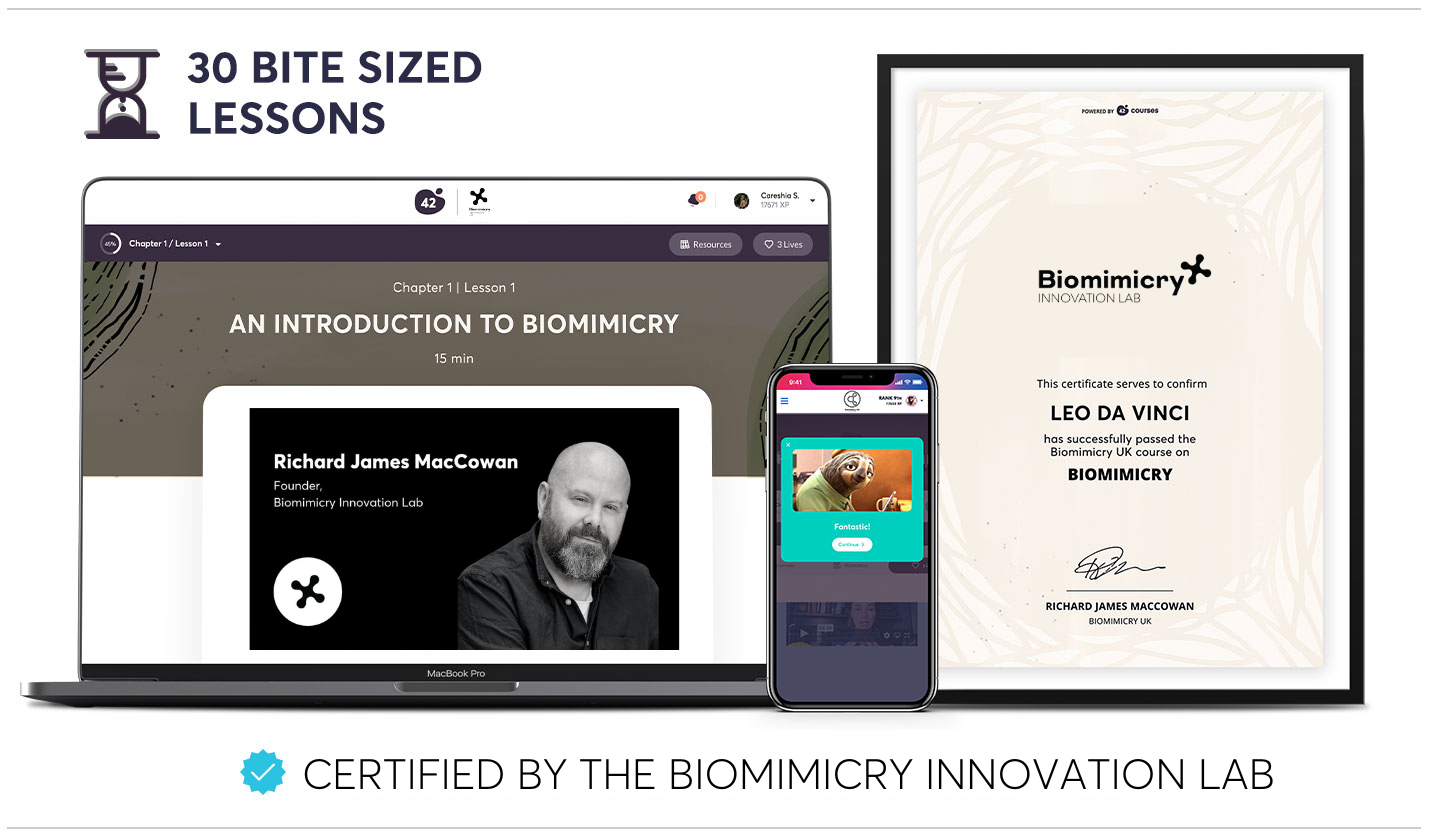
Quick, engaging lessons that still tell a story. Never dull. Each one is about 15 minutes, with video, short writing that actually makes a point, and a question to confirm the idea really landed.

💡

AI personalisation

Made for your job and your goals. Tell us what you do and what you want to improve. Every lesson is reshaped with practical takeaways for your role. The structure and evidence stay the same; the examples get rewritten so they match your reality.

💡

Real feedback

Support from a real person. Some of the questions are marked by members of our team. If you need direction, you'll get it. And if you're stuck, we're totally happy to jump on a call with you.

💡

The certificate

A Mini MBA you can keep. CPD-accredited, signed, dated, and trackable. When you finish, your completion rate lands above 80%, compared to an industry average that's more like 10%.


42courses vs typical online courses.

Feature 42courses Typical platform
Marking & feedback by real people ? Within 24 hours ' Auto-quiz only
Personalised by role & sector ? AI rewrites every lesson ' Same content for everyone
Taught by working practitioners ? The people who wrote the book ' Often academics or actors
Average completion rate ? Over 80% ' 5 to 15% (industry average)
CPD-accredited Mini MBA certificate ? Every course ' Sometimes
30-day money back, no questions ? If you aren't happy, we aren't ' Usually a 7-day refund window

Questions you might be wondering about.

Roughly eight hours total, broken into small lessons of around 15 minutes each. Most learners finish in about two weeks. There's no deadline though, and you can pause whenever work or life gets busy.
Not at all. We start with the basics and build your confidence from there. You'll get a fresh angle on the topic, drawing on insights from well-known voices in the field, whether you're just getting started or you've already got experience and want a sharper toolkit.
Each lesson ends with a short question to check your understanding. In every course, some of those questions are marked manually by our team. If you need a nudge, a real person will respond with notes to help you move forward. If you ever feel stuck, or you just want to talk it through, you can also book a call.
You've got 30 days from enrolment to request a full refund, no quibbles. No awkward exit questions, no endless email back-and-forth. We respond to refund requests within 24 hours, often faster. If you aren't satisfied, we'll sort it out with you.
Books can show you the theory. This course is where the practical part happens. We tailor each section to your role and goals, so you leave with clear, usable takeaways from every lesson.
Yes. Learners have used it across tech, healthcare, retail, banking, government, charities, and education. Each lesson is personalised to your role and objectives, so the examples and exercises adjust to fit your real context.
Yes. Most learning and development budgets can cover this without any hassle. If you need it, we can send a VAT-friendly invoice on request. Just email groundcontrol@42courses.com . If you're buying for 10 or more learners, take a look at Team plans .
It's a CPD-accredited certificate that's recognised throughout the UK and internationally for continuing professional development. It's personalised with your name, signed, dated, and trackable. Add it to your LinkedIn, pop it on your CV, include it in your performance review, or keep it somewhere safe at home.

Tools You'll Explore

Richard James MacCowan

Richard James MacCowan

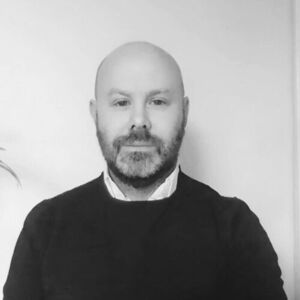
Richard MacCowan, founder and CEO of the Biomimicry Innovation Lab, is an award-winning urbanist with interests in behavioural economics and design inspired by nature. In 2012, he brought together the team behind the Biomimicry Innovation Lab, with the goal of taking research on nature-based design and making it work in commercial settings. Richard also works as an urban design consultant and leads efforts around Biomimicry, Biophilia, and Systems-thinking at the Leeds Sustainability Institute.

Biomimicry Innovation Lab

Biomimicry Innovation Lab

The mission of the Biomimicry Innovation Lab is to get people inspired and to share how nature can point us toward genuinely new solutions. They help innovators with the resources, guidance, and insights needed to improve how organisations approach innovation.

Frank Stephenson

Frank Stephenson

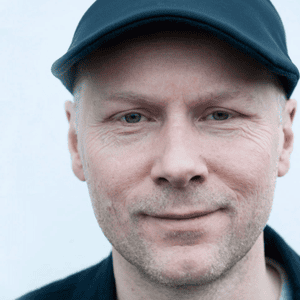
Frank Stephenson is a Moroccan-born American automotive designer who has worked with brands including Ford, BMW, Mini, Ferrari, Maserati, Fiat, Lancia, Alfa Romeo, and McLaren. Motor Trend has described him as 'one of the most influential automotive designers of our time'. He's been interested for years in using nature's ideas to influence car design and beyond.

Veronika Kapsali

Veronika Kapsali

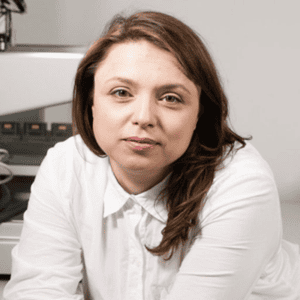
Dr Veronika Kapsali is a Professor of Materials Technology and Design at the London College of Fashion, University of the Arts London (UAL). She's passionate about connecting design with STEM, and she set up the Active Materials Lab to carry out cutting-edge research at the crossroads of biology, materials science, and design. Because of her expertise and the impact of her work, Dr. Kapsali received an AHRC leadership fellowship to move Bio-inspired Design forward.

Michael Pawlyn

Michael Pawlyn

Michael Pawlyn is a UK-based architect known for biomimetic architecture and innovation, and for helping to launch the 'Architects Declare' movement. He's delivered lectures internationally, and in 2011 one of his talks was featured on TED.com. It has since reached more than 1.8 million views. His book 'Biomimicry in Architecture' is also a publisher bestseller.

Lorenzo Mencattelli

Lorenzo Mencattelli

Dr. Mencattelli specialises in Composite Innovation and R&D project management. He brings strong scientific training in mechanics, design, analysis, and numerical methods for composite structures. That foundation is supported by an impressive record of scientific publications, patents, and research awards. After completing top BSC and MSC degrees in Aerospace Engineering at the University of Pisa and EPFL Lausanne, he earned his PhD at Imperial College London, where he developed disruptive bio-inspired design approaches for composites that can handle damage extremely well.

Ryan Church

Ryan Church

Ryan is the founder and CEO of Biome Renewables. The company sits where biologically inspired design meets entrepreneurship, engineering, materials, and systems. Ryan invented the PowerCone', and built Biome Renewables to bring breakthrough lab research into real-world commercial use. His work has earned him a Forbes 30 under 30 nomination in Energy. You can also find his contributions in publications like The Economist, plus he delivers talks through podcasts and in-person events for groups including Engineers Without Borders.

Julian Vincent

Julian Vincent

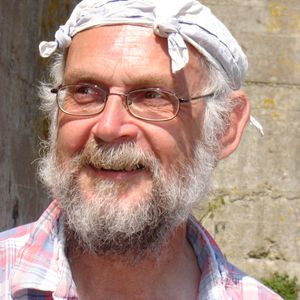
Julian Vincent always wanted to be a biologist. He's well known for pioneering work in biomimicry and biological engineering. Previously a professor at the University of Bath and the University of Oxford, Vincent focuses on the overlap between biology and technology, exploring how natural structures can inspire innovative engineering and design solutions. His research has helped shape the biomimicry field and encourages sustainable, efficient design principles drawn from the natural world.

Rupert Soar

Rupert Soar

Rupert Soar is recognised for his work in digital fabrication and biomimicry at Nottingham Trent University. His main focus is applying nature-inspired solutions to construction, particularly ideas inspired by termite mounds and the way they use resources efficiently. Rupert's research includes developing swarm robotics, using 3D printing for construction, and building algorithms based on termite behaviour to improve building methods. Overall, his goal is to bring these biological efficiencies into modern construction to help address resource scarcity.

Silvia Vignolini

Silvia Vignolini

Silvia Vignolini is Director of Sustainable and Bio-inspired Materials at MPI Potsdam, and a Professor in Chemistry and Bio-materials at the University of Cambridge. Her research looks at how natural structures control light, and she's working toward creating more sustainable materials. She also explores how these natural processes can inspire eco-friendly ways to produce artificial colour. Her work could eventually support safer, biodegradable alternatives to conventional colourants used in areas like cosmetics and textiles.

Tia Shaker

Tia Shaker

Tia is a freelance architectural designer and tutor. She has worked on major architectural projects that aim to reshape London's skyline, as well as work connected to the International Criminal Court in The Hague and a Big Data Institute in Oxford. Her work includes 3D modelling tools, BIM, and parametric design. She also researches biomimicry, and has published work on the topic.


What we'll cover, in order.

An Introduction to Biomimicry

An overview of biomimicry. What’s it all about? And why does it matter?
What is Biomimicry?
A Brief History
Why Biomimicry Matters
Translating Nature's Insights
Nature As A Tool For Innovation

How To Use Biomimicry

What is the process of using biomimicry to solve complex problems? This chapter explores the different ways of thinking to find bio-inspired solutions.
A Biomimicry Process
Step 1 - Define Your Problem
Step 2 - Look At How Nature Solves A Similar Problem
Step 3 - Prototyping
Step 4 - Iterate
Constraints, Compromises and Tradeoffs

Substance

In this chapter, we examine how different substances in nature can inspire our designs. How do organisms use materials to achieve their goals? What can we learn from this?
Materials Science
Self-Cleaning Surfaces
Pitcher Plant Porcelain
Sharkskin Anti-Fouling Material

Structure

Plants, animals, and fungi exist in structures that give them strength, flexibility, stability, or mobility without using a lot of substances. How might we apply these insights?
The Bare Bones of Flight
Penguin Feathers
Mantis Shrimp Composites
Spider Silk Textiles
Structural Colour

Energy

This chapter explores how nature uses energy and various techniques from the natural world that can help improve how we generate and use energy.
Solar Power
Batteries
Dampening Wind Turbine Noise

Information

Nature carries and communicates information in different ways. We look closely at these ingenious methods to inspire our information age.
Swarm Intelligence
Water Reactive Materials
Aquaporin Water Filters

Space

In this chapter, we look at how different life forms move through space. From dinosaurs to amoebas, we can learn techniques to improve our current designs.
Fly On Eagle's Wings
Making Supercars Go Faster
PAX Lily Impeller

Time

Time changes everything, and we can learn much from how nature takes advantage of changes over time.
Be Cool Baby, Be Cool
Self Repairing Concrete
Making Water In The Desert

Certification Process

1

Complete all the classes

Attend classes, ask questions, and finish your homework. We check your activity and support your learning journey every step of the way.

2

Get the Summary Notes

Receive high-quality supporting documents, summary notes, and recommended readings. Ensure you have access to all tools and resources.

3

Complete 100% Impact

Complete the final assessment to validate your learning. Earn your certificate and share your achievement with your professional network!

Biomimicry
Free

This Course Includes:

Level Access
9h of Content
Certificate of Completion
English

Get Certified

Add value to your profile

Certificate Preview
Official Certificate